


Supporting Composting Education in Schools
U.S. schools generate over 530,000 tons of food waste every year, much of which ends up in landfills where it releases methane, a potent climate pollutant. Schools already face tight budgets, limited staff capacity, and rising waste disposal costs, making traditional environmental programs difficult to sustain. Composting programs often fail because they rely on expensive outside labor, complex infrastructure, or one-time lessons that don’t stick.
Our work addresses this problem directly through a classroom-based, kit-powered, and educator-supported model that is affordable, scalable, and built to last long after the first lesson is taught.
Our Classroom Composting Program is Simple, Sustainable, and Built for Impact
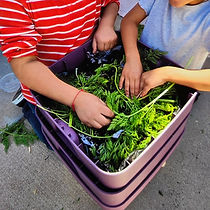
Vermicomposting Integrated Into the School Day
Our hands-on model brings composting into the classroom where students can feed the worms daily, track changes over time, and connect their actions to real environmental outcomes. Entry-level worm composting kits become part of the school routine, making it sustainable even in busy classrooms.
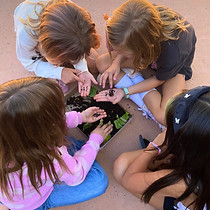
Hands-On STEAM/STEM Learning for All Ages
Our award-winning curriculum strengthens core science skills through real investigations in biology, engineering, measurement, systems thinking, data collection, and climate literacy. It prepares students for real-world careers in environmental science, agriculture, engineering, and sustainability.
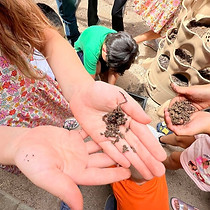
Schools Reduce Food Waste and Cut Methane Emissions
Diverting food waste allows schools to cut down on landfill contributions and associated methane emissions, a key climate solution emphasized by international environmental agencies. Students see the impact firsthand, building long-term habits that extend beyond school into their homes and communities.
How Our Program Works
-
We Provide the Tools: Schools receive five weeks of our free, award-winning NGSS-aligned STEAM K-12 curriculum, including lesson plans, pre/post assessments, worksheets, presentations, and more. Select classrooms also receive indoor worm compost farm kits and ongoing support.
-
Students Take Action: Students run the compost system, feed worms, observe decomposition, conduct experiments, and track data. Learning becomes active, daily, meaningful, and something they can expand over time.
-
Schools Reduce Waste: Over time, students proactively generate less food waste via source reduction and compost diversion, reducing landfill-bound organics and creating a closed-loop system that continues beyond our initial support. This is operational change that expands from one classroom into multiple grade levels, and then into the cafeteria setting.
-
Economically Feasible: Schools do not need new staff, infrastructure, or expensive equipment. A single kit serves an entire classroom for years. Our train-the-trainer model ensures educators can operate the program independently once trained.
-
Scalable Across Grades K–12: Our five-week curriculum is designed for every grade level, ensuring vertical alignment across a school or district. This lets administrators adopt a consistent, cross-campus model.
-
Long-Term Sustainability: Because composting becomes part of the school day, not an after-school add-on, high-impact habits persist. Students carry these skills into the cafeteria, home, and community.
Reducing Barriers to Environmental Education with Free Composting Kits
We provide a limited number of funded composting education opportunities each year to qualifying organizations, based on eligibility, program type, and available funding. Selected participants may receive composting equipment, educational resources, training, and ongoing support, depending on the program.
Expand Access to Composting
Let's Go Compost is a national 501(c)(3) nonprofit making composting education more affordable and accessible for hundreds of communities across the United States.
Your support helps us expand educational programs, develop free resources, improve access for underserved communities, and inspire the next generation of environmental stewards through hands-on composting. Every donation, no matter the size, helps more people discover the benefits of composting, reduce food waste, and build healthier soil for the future. Thank you for helping grow a more conscious world.
Expand Environmental Learning with Our Early Childhood Composting Book
.jpg)
Educators looking to strengthen early childhood environmental education can add “The Wild West of Waste”, written by Let's Go Compost founder Lauren Click, to their shelves. The story introduces composting, soil health, and responsible resource use in an engaging, age-appropriate way for young readers. It pairs well with STEM storytimes, gardening activities, and sustainability programs for families.
Public schools, home schools, school libraries, and educators can purchase the book through major retailers, and every sale directly supports our nonprofit’s free composting programs nationwide. Adding it to your collection expands access to hands-on learning while reinforcing community environmental literacy.
For bulk copies for programs, classroom kits, or giveaways, email us at hello@letsgocompost.org.
Available Where Most Books Are Sold


Prefer to shop local? Ask your independent bookstore to order your copy of The Wild West of Waste through IngramSpark using the title and author name.
An Award-Winning Program in Environmental Education
Let’s Go Compost has been featured across local, regional, and national print, live television, media, and radio campaigns. The organization has also been invited to share its educational model at national and international education and sustainability forums, including the United Nations World Food Forum, the Commission for Environmental Cooperation JPAC Forum, and the U.S. Composting Council National Conference.
Let's Go Compost's founder, Lauren Click, has been recognized through multiple national and international honors in composting and environmental education, including Young Professional of the Year from the U.S. Composting Council and North American Winner of the United Nations Food and Agriculture Organization and World Food Forum AgX Challenge. Additional recognitions include honors from the Center for Green Schools at the U.S. Green Building Council and the Green Schools National Network, selection as a United States Representative for the Generation of Environmental Leaders at the Commission for Environmental Cooperation, and inclusion in the Women of the Future 50 Rising Stars in ESG by Tesco and Reed Smith. Let’s Go Compost has also received Nonprofit of the Year awards from Circular Arizona and the Arizona Association for Environmental Education.


You can help make this program possible.
Your donation helps provide composting kits and education to schools and communities that cannot afford them. Sponsor a kit here.